How to Politely Ask for Payment on WhatsApp (Without Losing the Customer)
A practical guide for Indian small businesses: when to send WhatsApp payment reminders, what to write, and how to escalate politely — with real message examples.
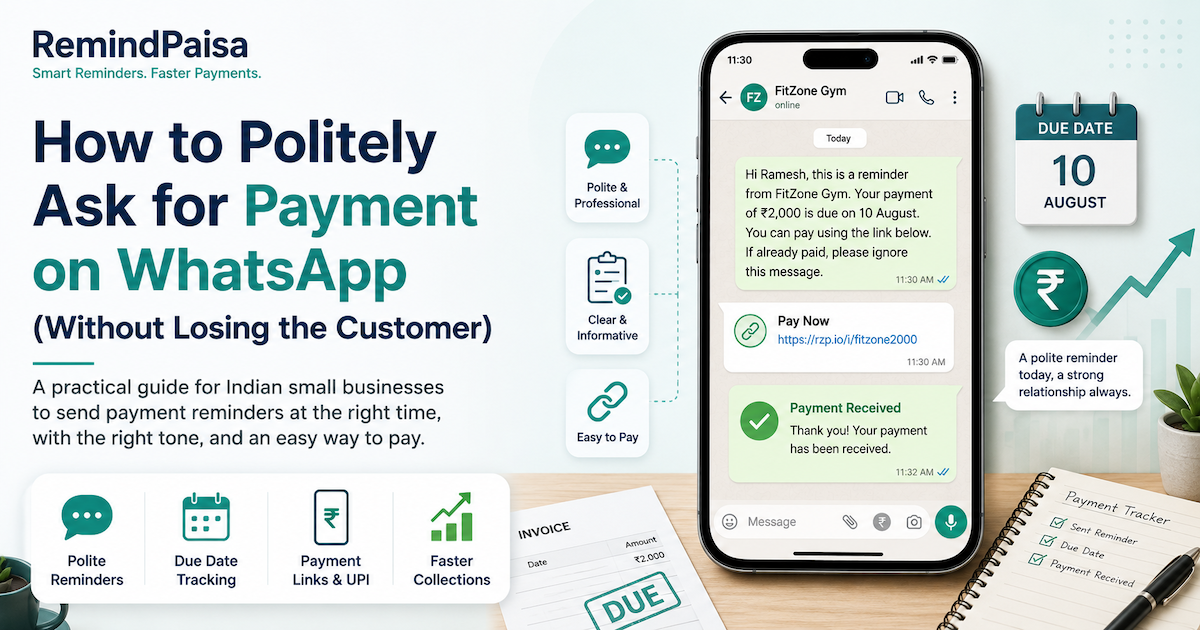
TL;DR: The politest payment reminder is a short, factual message sent at the right time — before the due date, not weeks after. State the amount, the due date, and how to pay, include a payment link, and keep emotion out of it. Most customers pay after one or two well-timed reminders; the tone problems start only when you remind too late and too angrily.
Why is asking for payment so awkward?
Because you're mixing a relationship with a transaction. A gym owner messaging a member, a coaching institute messaging a parent, a freelancer messaging a client — in every case you'll see that person again, so you don't want the money conversation to feel like a fight.
The fix is not better wording. It's making reminders routine. When a reminder arrives on a predictable schedule, looks professional, and includes an easy way to pay, it reads as "the system reminded me" — not "the owner is chasing me." That single shift removes most of the awkwardness for both sides.
When should you send a payment reminder?
Send the first reminder before the due date, not after. A simple schedule that works for most Indian small businesses:
| Timing | Purpose | Tone |
|---|---|---|
| 3 days before due date | Friendly heads-up | Warm |
| On the due date | Payment is due today | Neutral, factual |
| 3 days after | Gentle follow-up | Polite but direct |
| 7–10 days after | Firm reminder | Professional, mentions consequences |
Two rules inside that schedule:
- Never skip the pre-due reminder. A large share of "late payers" simply forgot. Reminding before the due date lets them pay on time and never feel chased.
- Space follow-ups out. Daily messages feel like harassment and get you blocked. Every 3–4 days is persistent without being hostile.
What should a polite WhatsApp payment reminder say?
Every good reminder has four parts: who you are, what is due, when it is due, and how to pay. Nothing else is required.
Before the due date:
Hi Ramesh, this is a reminder from FitZone Gym. Your membership fee of ₹2,000 is due on 10 August. You can pay via the UPI link below — thank you!
On the due date:
Hi Ramesh, your payment of ₹2,000 to FitZone Gym is due today. Pay in one tap using the link below. If you've already paid, please ignore this message.
After the due date:
Hi Ramesh, our records show ₹2,000 due to FitZone Gym on 10 August is still pending. Could you complete the payment using the link below? If there's an issue, just reply to this message.
Notice what these messages don't do: no "kindly do the needful," no guilt ("we are a small business"), no exclamation marks pretending it isn't about money. Short and factual is the polite version.
For more ready-made messages, see our 15 WhatsApp payment reminder templates.
How do you escalate without damaging the relationship?
Escalate the facts, not the emotion. A firm reminder at day 10 still uses calm language — it just adds specifics:
Hi Ramesh, the payment of ₹2,000 due on 10 August is now 10 days overdue. Please complete it by 25 August so your membership continues without interruption. Use the link below, or reply here if you'd like to discuss.
Three things make this work:
- A concrete next date ("by 25 August") instead of "as soon as possible."
- A stated consequence that is real and proportionate (membership pause, late fee you actually charge, work on hold).
- An open door ("reply here") — customers with a genuine cash-flow problem will tell you, and a part-payment plan beats an unpaid invoice.
If a customer disputes the amount, move the conversation off reminders immediately and resolve it — never keep auto-reminding someone who has raised a genuine question.
Why include a payment link in every reminder?
Because the reminder's job is not to inform — it's to get you paid. Every extra step between "read the message" and "money sent" loses people. A reminder with a UPI link or QR code lets the
customer pay in the same minute they read it, from the same app.
This also answers the politeness question: a message that makes paying effortless feels like a service. A message that says "please pay" with no way to act feels like a demand.
With RemindPaisa, every WhatsApp reminder carries your UPI details (QR code + UPI ID) or a Razorpay payment link automatically, and payments go directly to your account —
RemindPaisa never holds your money.
Should you automate payment reminders?
If you have more than a handful of customers, yes — for one reason above all: consistency is what keeps reminders polite. Manual reminders get sent late, skipped when you're busy, and written in whatever mood you're in that day. An automated schedule sends the same professional message at the same right time, every time, and keeps a record of what was sent.
Automation also fixes the follow-up gap: it's easy to send one reminder, but collections mostly happen on the second and third touch — the ones humans forget to send.
RemindPaisa was built for exactly this: set the schedule once, and reminders go out on WhatsApp with a payment link in every message, while you track paid, unpaid, and overdue in one dashboard.You can start free and see the effect on your collections within one billing cycle.
Frequently asked questions
Is it legal to send payment reminders on WhatsApp in India?
Yes. Sending a payment reminder for a genuine due amount to your own customer is a normal business communication. Use approved WhatsApp Business templates, keep the content factual, and stop messaging anyone who asks you to — harassment rules apply to conduct, not to the reminder itself.
How many reminders should I send before calling?
Three or four messages over about two weeks. If there's no response after a firm reminder with a clear deadline, a phone call is the right next step — some conversations need a voice.
What if the customer says "I'll pay next week" every time?
Convert promises into specifics: reply confirming the exact date and amount ("Noted — ₹2,000 by Friday, 22 August"), and send the next reminder on that date, referencing the promise. People honour commitments they made in writing far more often than vague ones.
What's the best time of day to send a reminder?
Late morning (10 am–12 pm) on weekdays works well — people are at their phones and can act immediately. Avoid late-night messages; they feel aggressive and get ignored until morning anyway.
Stop chasing payments manually
RemindPaisa sends WhatsApp reminders automatically — so you get paid faster.
Try RemindPaisa free →