How Subscription Businesses Can Reduce Missed Renewals with Automated WhatsApp Reminders
Most subscription customers don't cancel — they just miss the renewal. Here's how Indian subscription businesses use automated WhatsApp reminders with payment links to cut involuntary churn.
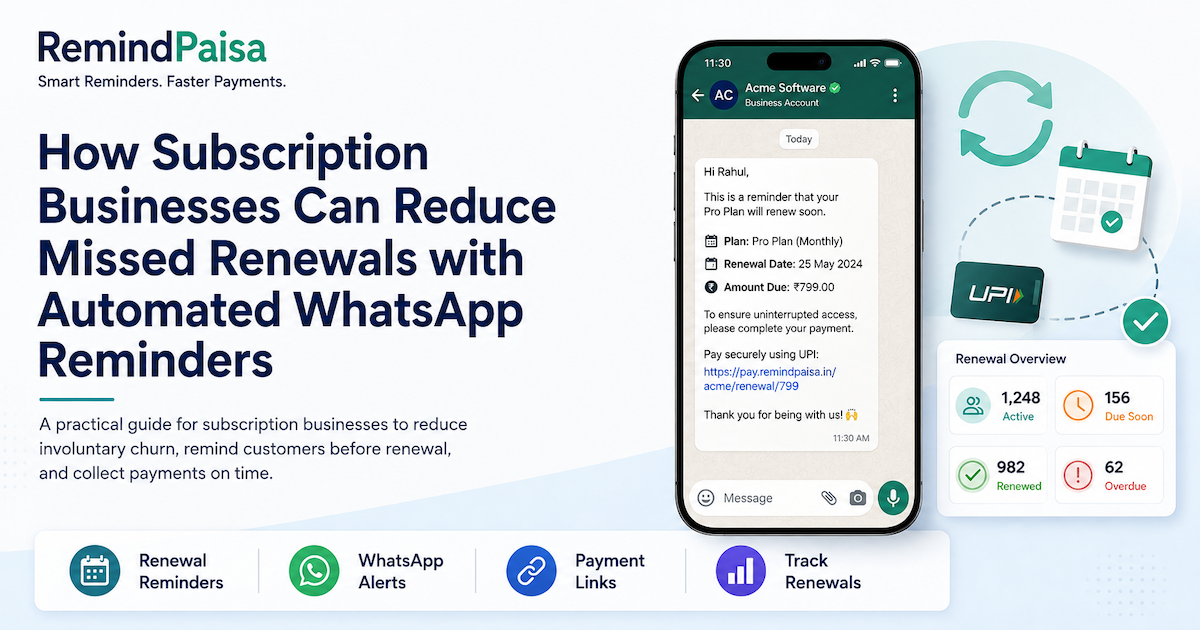
TL;DR: In most small subscription businesses, the customers you lose each month didn't decide to leave — their renewal date passed and nothing prompted them to pay. This "involuntary churn" is the cheapest revenue you can recover: send an automated WhatsApp reminder before the renewal date with a UPI or Razorpay link, follow up twice during a short grace period, and record every renewal against the customer. No new marketing, no discounts — just renewals that stop slipping through.
What is involuntary churn — and why is it killing small subscription businesses?
Involuntary churn is when a paying customer lapses without ever deciding to cancel. The renewal date arrives, no payment happens, the service quietly stops or continues unpaid — and weeks later both sides have moved on.
For Indian subscription businesses — internet and cable operators, water-can and milk delivery, meal plans, content and community subscriptions, service AMCs, software sold on monthly plans — this is usually the largest source of lost revenue, bigger than customers who genuinely quit. And it's uniquely painful because the customer was happy. They weren't price-shopping or dissatisfied; nobody asked them to pay at the right moment.
The math is brutal at small scale: a business with 200 subscribers at ₹500/month that lets just 8% of renewals slip each month loses about ₹8,000 monthly — nearly ₹1 lakh a year — to customers who would have paid if asked.
Why do renewals get missed in the first place?
Three reasons, none of them the customer's "fault":
- There is no bill moment. A one-time sale ends with a payment request. A subscription renews invisibly — unless you create the moment, it doesn't exist.
- Auto-debit doesn't cover most of this market. E-mandates and UPI AutoPay exist, but many customers of small businesses hesitate to authorise auto-debits, and many small merchants aren't set up to offer them at all. In practice, most Indian micro-subscriptions renew on a manual payment.
- Manual tracking collapses past a few dozen subscribers. With 50+ customers on different start dates, "who renews this week?" becomes a daily spreadsheet chore that loses to more urgent work.
So the realistic model for most small subscription businesses is reminder-driven renewal: no mandate paperwork, no gateway lock-in — a well-timed message with a payment link, every cycle, automatically.
What does a good renewal reminder sequence look like?
Tie the sequence to each customer's renewal date, and keep a short, defined grace period after it:
| Timing | Message | Goal |
|---|---|---|
| 4–5 days before renewal | Upcoming renewal, amount + payment link | Renew before lapse — the ideal outcome |
| Renewal day | Plan renews today, one-tap link | Catch the "I'll do it today" payers |
| 3 days after (grace) | Payment pending, service continues till X | Recover the forgetters |
| 7 days after (grace ends) | Final notice before service pauses | A real, stated boundary |
Two principles inside that table:
- Define the grace period and honour it. "Service continues till the 7th, then pauses" is fair, professional, and creates the deadline that vague pending-payment messages lack. Businesses that never pause anything teach customers that renewal dates are decorative.
- After the grace period, stop the sequence. A customer silent after four messages needs a call or a win-back message next month — not reminder number five.
What should a renewal reminder say?
State the service, the period being renewed, the amount, and the link — and always leave the "already paid?" escape hatch:
Before renewal:
Hi Sunil, your Netlink Home internet plan renews on 1 October — ₹799 for the month. Renew now with the link below and your connection continues without interruption.
On renewal day:
Hi Sunil, your ₹799 Netlink plan renews today. Pay in one tap using the link below. Already paid? Please ignore this message.
During grace:
Hi Sunil, your Netlink renewal of ₹799 is pending. Your connection stays active till 7 October — complete the payment with the link below to continue beyond that. Any issue with the service? Just reply here.
That last question is not politeness — it's churn defence. A customer who is lapsing deliberately will often tell you why when asked in a reminder, and a service complaint you can fix is worth far more than one recovered payment.
Why WhatsApp instead of email or SMS for renewal reminders?
Because a renewal reminder only works if it's seen before the lapse — and in India, WhatsApp is where messages get seen the same day. Email renewal notices from small businesses largely go unopened; SMS gets read but supports no rich payment experience. A WhatsApp reminder carries the UPI QR, the payment link, and your business identity in one message the customer can act on in 30 seconds.
There's also a compounding benefit: when renewals arrive predictably on WhatsApp every cycle, paying becomes a monthly reflex. The reminder stops being a nudge and becomes the customer's billing system.
How do you automate this without becoming a software company?
The renewal cycle is the most automatable process in your business, because every input is known in advance: who subscribes, at what price, renewing on which date. What you need is a system where each customer is set up once — plan amount, cycle (monthly, quarterly, annual), renewal date — and from then on it generates the due each cycle, runs the reminder sequence on WhatsApp with your payment link, stops the moment a payment is recorded, and shows you a single live list of paid, pending, and overdue subscribers.
That's precisely the job RemindPaisa does for subscription businesses: recurring invoices per customer, automated WhatsApp reminders with your own UPI details or Razorpay payment link in every message, and a dashboard that replaces the renewal spreadsheet. Payments go straight to your account — RemindPaisa never touches the money. You can start free and put one month's renewals through it before deciding anything.
How do you win back subscribers who lapsed months ago?
Don't fold win-backs into your reminder sequence — they're a different message with a different tone. Once a quarter, send lapsed customers a short, warm note: what's improved, what the current plan costs, and a link to restart. Two rules: never guilt them about the lapse ("we noticed you left us…" reads worse than you think), and stop after one attempt per quarter. A clean, honest restart message recovers a meaningful slice of past customers precisely because it's rare.
Frequently asked questions
How many renewal reminders are too many?
Four per cycle — spread from a few days before renewal to the end of grace — is the practical ceiling. Beyond that you're training customers to ignore you, and risking blocks that cut off the channel entirely.
Should I offer a discount to customers who miss renewals?
No — that trains everyone to miss renewals. Keep pricing identical whether they pay early or in grace. Reserve incentives for genuinely lapsed win-backs or for switching to longer plans (quarterly/annual), which reduces how often renewal can be missed at all.
Is it better to move everyone to the 1st of the month?
Only if your service naturally runs calendar-monthly (like meal plans). For date-of-joining renewals, a common billing date creates messy pro-rata math at signup. Automated per-customer reminders make scattered renewal dates painless anyway.
What about customers who always pay 10 days late?
Shorten their runway, don't extend it: start their reminders earlier and, if the pattern holds, move them to quarterly prepaid or a stricter grace. Chronic lateness at renewal is a payment-terms problem, not a reminder problem.
Stop chasing payments manually
RemindPaisa sends WhatsApp reminders automatically — so you get paid faster.
Try RemindPaisa free →